Your recruiters aren't slow. They're buried. Applications per hire tripled between 2021 and 2024, your team got smaller, and now everyone's working beyond capacity just to keep reqs moving. The bottleneck isn't sourcing. It's the 20 to 30 hours per week your team loses to toggling between LinkedIn, your ATS, Gmail, and Slack, copying candidate details by hand and managing workflows that span six different browser tabs. High-volume recruiting automation that operates across those systems, not inside individual tools, is what finally breaks the recruiter capacity ceiling without requiring budget you don't have for headcount that won't solve the structural problem anyway.
TLDR:
- Recruiting teams face 93% more applications since 2021 while team size dropped from 31 to 24 people on average. Your recruiters aren't slow, they're buried under volume that outpaced hiring by 3x.
- Recruiters lose 20 to 30 hours weekly to manual tasks like toggling between LinkedIn, your ATS, and Gmail, with up to 75% of work hours spent on process overhead instead of candidate conversations.
- Cross-system workflows create the real bottleneck: traditional ATS tools automate individual tasks but leave the connective work between LinkedIn, email, calendars, and Slack entirely manual.
- Browser automation runs multi-step sequences across all your recruiting tools in one workflow—no API connectors, no re-authentication, no middleware to bridge gaps between systems.
- Composite runs up to 5 concurrent candidate workflows across your existing stack (LinkedIn, ATS, Gmail, Sheets) with SOC-2 Type 2 compliance and zero data retention with AI subvendors.
The High-Volume Recruiting Capacity Ceiling
Recruiting teams are fielding 93% more applications than in 2021, yet the teams reviewing those applications have gotten smaller. The average recruiting department has shrunk from 31 people in 2022 to 24 today, and 62% of HR departments report working beyond their typical capacity.
That gap between inbound volume and available headcount is the recruiter capacity ceiling. It shows up when time-to-fill stretches, when qualified candidates slip through because no one reviewed their profile in time, and when every open req competes for the same finite hours of recruiter attention.
Hiring more recruiters used to be the default fix. But with budgets tightening and application volume still climbing, headcount alone can't close the gap. The constraint is structural, and it has very little to do with how hard your team works.
Where Recruiter Time Actually Goes in High-Volume Hiring
Most recruiters assume they spend the bulk of their week on candidate-facing work. The numbers tell a different story. Recruiters routinely lose 20 to 30 hours per week to manual processes, which can consume up to 75% of their total working hours.

Where does that time go? Talent teams report spending 38% of their time just scheduling interviews. And in-house recruiters spend nearly two hours each day on administrative tasks, adding up to more than a full workday every week. ATS management and data entry eat up most of those hours.
That leaves a sliver for the things that actually move hires forward: sourcing, relationship-building, selling candidates on the role. When three-quarters of a recruiter's week goes to process overhead, adding more reqs to their plate doesn't create a capacity problem. It exposes one that was already there.
Recruiting Metric | Current Benchmark | What It Reveals About Capacity |
|---|---|---|
Weekly hours lost to manual processes | 20 to 30 hours per week, up to 75% of total working hours | Most recruiter time goes to process overhead instead of candidate-facing work |
Time spent on interview scheduling | 38% of total talent team hours | Coordination and logistics consume more time than sourcing or relationship-building |
Daily administrative task time | Nearly 2 hours per day for in-house recruiters | ATS management and data entry add up to more than a full workday every week |
Application volume increase since 2021 | 93% more applications, with applications per hire tripling to over 300 | Inbound volume has scaled faster than teams can review it, creating triage bottlenecks |
Average recruiting team size change | Shrunk from 31 people in 2022 to 24 today | Teams are smaller while handling much higher volumes, exposing the structural constraint |
The Application Volume Surge Creating the Bottleneck
The volume increase isn't a blip. Applications per role have doubled since spring 2022, and applications per hire tripled between 2021 and 2024, staying above 300 throughout 2025.
Two forces feed that surge. One-click apply features and simplified job board interfaces have lowered submission friction to near zero. At the same time, candidates are using AI writing tools to generate tailored resumes and cover letters at speed, so a single job seeker can blanket dozens of postings in an afternoon.
For recruiters, the downstream effect is brutal. More applications per req means more screening time per req, but the hours in a week haven't changed. When inbound volume scales faster than a team's ability to review it, the bottleneck isn't sourcing. It's triage.
What Traditional Recruiting Automation Misses
ATS resume parsing, email sequencing, and interview scheduling tools each solve a discrete task well. They cut time from individual steps. But the work that actually buries recruiters isn't any single step. It's the connective tissue between steps: toggling from LinkedIn to a sourcing tool, copying candidate details into the ATS, cross-referencing a hiring manager's notes in Slack, then drafting outreach in Gmail.
Those multi-step, cross-system workflows remain almost entirely manual. No scheduling tool knows how to pull context from your ATS, check a candidate's latest LinkedIn activity, and adapt your outreach tone accordingly. Each tool automates its own silo. The gaps between silos are where recruiter hours disappear.
That distinction matters for any team trying to break past a recruiter capacity ceiling. Single-task automation raised the floor. It never removed the ceiling, because the ceiling lives in the browser-based work that stitches everything together.
The Cross-System Workflow Tax
A single candidate touchpoint might span LinkedIn, your ATS, a company website, Gmail, Google Calendar, and Slack. Across the hundreds of candidates a high-volume recruiter juggles at once, the tab-switching alone becomes a job unto itself. Knowledge workers routinely move between eight to twelve different web applications during standard workflows, copying information by hand from one system to the next.
Each context switch carries a small cost: reorienting, finding the right record, remembering where you left off. At low volume, those costs are invisible. At high volume, they compound into hours. A recruiter processing fifty new applicants in a morning isn't doing one workflow fifty times. They're doing six or seven micro-workflows per candidate, across a dozen browser tabs, with zero connective thread between them.
How Browser Automation Changes the Capacity Equation
Browser automation works at a different layer than the tools described above. Instead of automating inside a single application, it operates on top of the browser itself, executing click-by-click sequences across whatever sites and tabs are open. A single automated workflow can move from LinkedIn to your ATS to Gmail without requiring API connectors or middleware to bridge the gaps.
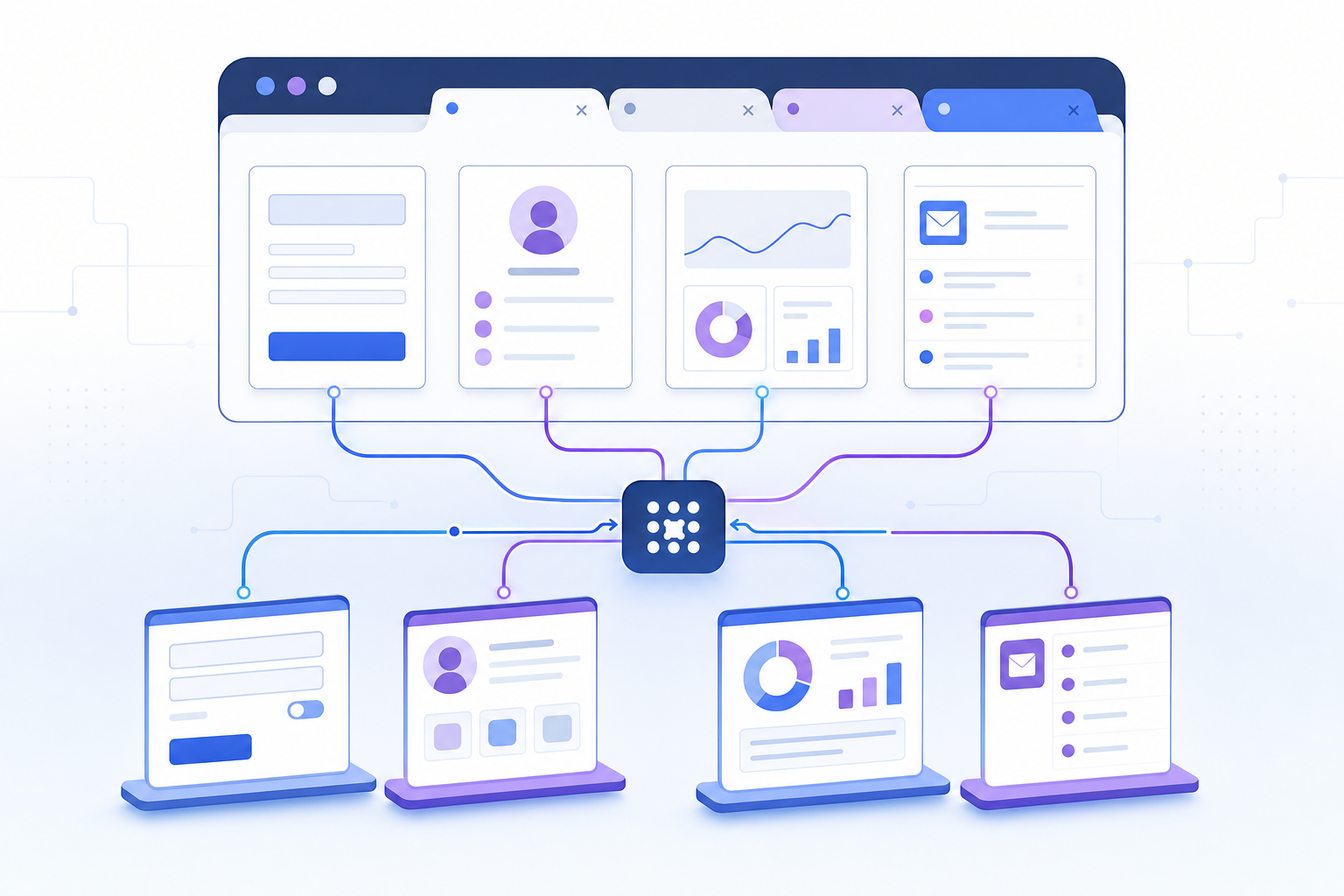
The category spans a range. No-code tools like Selenium-based recorders let teams script repeatable sequences manually. AI-powered browser agents go further: you describe a task in plain language, and the agent plans and runs the steps in real time, adapting as pages load and layouts shift.
What both share is the ability to act where recruiters actually work. Because the automation runs inside the browser session, it inherits the same logins, permissions, and context a human recruiter already has.
Recruiter Productivity Metrics That Reveal Capacity Limits
Four metrics tend to flash red before a team recognizes it has hit its ceiling. Tracking them together gives you a clearer picture than any single number can.
- Reqs per recruiter: the widely cited baseline is 14 open reqs per recruiter. Once your team consistently runs above that line, response times stretch and candidate experience suffers.
- Hires per recruiter per quarter: if this number is flat or falling while req volume grows, your team is absorbing more work without producing more output.
- Time to fill: the current average sits around 44 days. A creeping increase here often reflects process drag, not a weak talent market.
- Application to interview conversion rate: when inbound volume spikes but interview slots stay constant, conversion drops. That declining ratio signals screeners can't keep pace with the queue.
If two or more of these are trending in the wrong direction, the recruiter capacity ceiling is already pressing down.
How Composite Uses Browser Automation to Eliminate Recruiter Busywork
Composite plugs into the Chromium browser you already use. Hit Cmd + Shift + Space, describe a task in plain English, and it runs the full click-by-click sequence across LinkedIn, your ATS, Gmail, Google Sheets, or any other web tool in your recruiting stack. No API keys, no re-authentication, no browser migration.
Pro plans support up to 5 concurrent threads, so recruiters can process multiple candidates in parallel. A multi-model AI architecture routes each step to the best-fit model for speed and accuracy, and because everything executes locally inside your existing browser session, logins and permissions carry over automatically.
Composite doesn't replace your ATS or sourcing tools. It wires them together, handling the cross-system workflows that bury your team so recruiters can spend their hours on candidate conversations and hiring manager alignment. SOC-2 Type 2 compliance and a zero data retention policy with AI subvendors clear the security reviews that typically stall automation rollouts in enterprise recruiting orgs.
Final Thoughts on Scaling Your Recruiting Team Without Adding Headcount
You already know where your team's hours disappear: toggling between systems, copying candidate details, cross-referencing notes across Slack and your ATS. Point solutions automate their own silos but leave the gaps untouched. Composite wires the whole recruiting stack together so your team can process candidates in parallel instead of drowning in browser tabs. Reach out if you want to see how it works with your existing tools.
FAQ
What's the best way to break past a recruiter capacity ceiling without adding headcount?
Browser automation that runs multi-step workflows across your existing recruiting stack (LinkedIn, ATS, Gmail, calendars) without requiring API connectors or manual tab-switching. This eliminates the cross-system work that consumes up to 75% of recruiter hours, letting your current team handle higher application volume without adding seats.
How much time do recruiters actually lose to manual processes in high-volume hiring?
Recruiters routinely lose 20 to 30 hours per week to manual processes, which can consume up to 75% of their total working hours. Talent teams report spending 38% of their time just scheduling interviews, and in-house recruiters spend nearly two hours each day on administrative tasks: more than a full workday every week on ATS management and data entry alone.
Traditional recruiting automation vs browser automation for scaling teams?
Traditional ATS tools, email sequencers, and scheduling platforms each automate a single task within their own silo, but leave the connective work between systems entirely manual. Browser automation operates at a different layer: on top of the browser itself. That means it can chain actions across LinkedIn, your ATS, Gmail, and calendars in one workflow without needing API integrations or middleware to bridge the gaps.
Can browser automation handle multiple candidates at once?
Yes. AI-powered browser agents with multi-threading support can process multiple candidates in parallel, running separate workflows simultaneously across different tabs and tools. This matters for high-volume teams where sequential processing creates bottlenecks, especially when application volume has doubled since 2022 and applications per hire have tripled.